

To use a video or image as your webcam, install a virtual camera app, load your file, then select that camera inside Zoom, Microsoft Teams, Google Meet, Discord or OBS. On Windows the simplest free option is FakeCam: it turns any video clip or photo into a webcam in a few clicks, with no signup.
This guide explains what a virtual camera is, how to set one up, which apps it works with, and the honest pros and cons next to other methods.
What is a virtual camera?
A virtual camera is a software webcam that other apps treat exactly like a physical USB camera. Instead of a lens, its picture comes from a source you choose: a video file, a still image, or another program's output. When you select it in a meeting app, that app sends your chosen picture to the call.
FakeCam registers one virtual camera on Windows and feeds it whatever video or image you load. Because it looks like an ordinary camera, any app with a camera selector can use it.
How to use a video as your webcam in 4 steps
- Download FakeCam and register its virtual camera (a one-time click).
- Drag your video file into the FakeCam window. The preview appears immediately.
- Press Play, and turn on Loop if you want the clip to repeat without a cut.
- Open your meeting app and choose FakeCam in its camera settings.
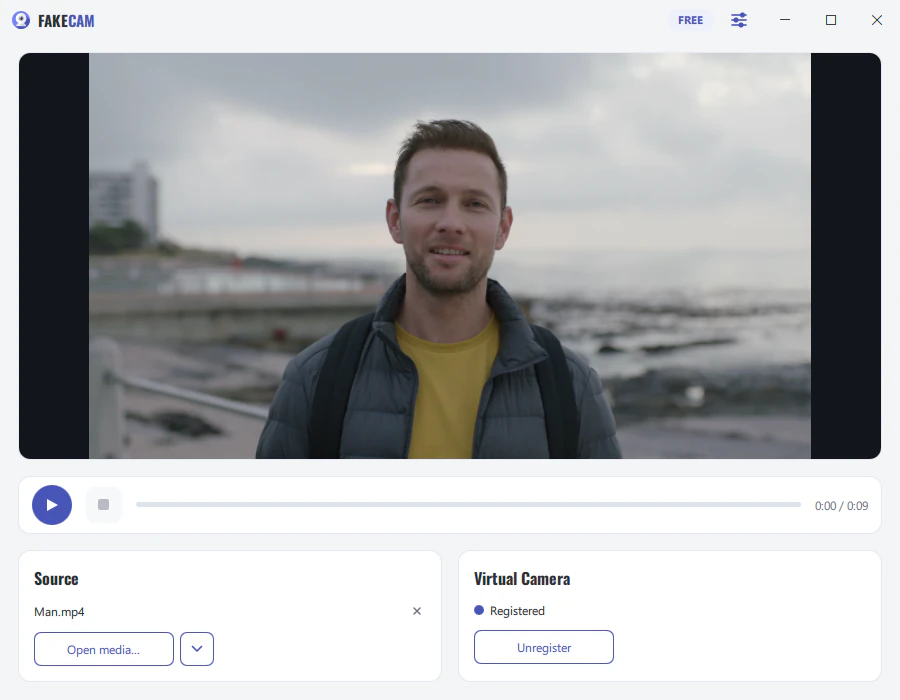
For a full walkthrough with screenshots, see the step-by-step Zoom guide.
How to use a static image as your webcam
The steps are the same, but you load an image (PNG, JPG or BMP) instead of a video. FakeCam holds that picture as a steady camera feed, which is useful for showing a clean background, a profile card, or a "be right back" screen instead of your live room.
Which apps does this work with?
FakeCam uses a Windows DirectShow camera, which the large majority of desktop apps support. A few newer apps read only the modern Media Foundation camera type and may not list it.
| App | Works with FakeCam | Notes |
|---|---|---|
| Zoom (desktop) | Yes | Pick FakeCam in Settings > Video |
| Microsoft Teams (desktop) | Yes | Use the desktop app, not the web version |
| Google Meet | Yes | Choose FakeCam in the camera menu |
| Discord | Yes | Start FakeCam before opening Discord |
| OBS Studio | Yes | Add it as a video capture device |
| Skype | Yes | Select it in the audio and video settings |
If your app does not list FakeCam, start the camera before opening the app, because most apps read the camera list only when they launch. Our FAQ covers the common fixes.
Video as webcam: methods compared
There is more than one way to put a video into a call. Here is the honest comparison.
| Method | Free | No watermark | Loops a video | Works in any app | Setup effort |
|---|---|---|---|---|---|
| FakeCam | Yes | With PRO | Yes | Yes | Low |
| OBS Studio virtual camera | Yes | Yes | Needs setup | Yes | High |
| ManyCam (free tier) | Partly | No | Yes | Yes | Medium |
| Sharing your screen | Yes | Yes | No | Limited | Low |
OBS is powerful and free, but it is a full studio: you build a scene, add a media source, set it to loop, then start the virtual camera. If all you want is to play a file as your camera, a dedicated tool is faster. ManyCam can do it too, but its free tier adds a watermark.
Legitimate ways people use this
A virtual camera is a normal creative and professional tool. Common, honest uses include:
- Presentations and demos: play a pre-rendered product demo into a meeting instead of sharing your screen.
- Privacy and a clean look: show a tidy image or a calm looping background rather than your room.
- Software testing and QA: feed a known, repeatable video into any app that reads a camera.
- Accessibility: present a chosen image or clip when you would rather not be on a live camera.
- Content creation and streaming: loop branded or B-roll footage as a source.
- Education and training: run a recorded demonstration as the camera while you narrate live.
FakeCam does not add face filters or AR effects, and it is not meant to impersonate another person. It simply sends the video or image you choose.
Troubleshooting: the camera does not show up
The most common fix is the order of launch: start FakeCam and press Play first, then open the meeting app, because apps read the camera list at startup. Also check that the virtual camera is registered and that Windows allows desktop apps to use the camera. For app-specific steps, see the Zoom guide and the FAQ.